Serve-and-Volley or Baseline Play: Two Ways to Take the Court
Serve-and-volley or baseline play shapes where a tennis player stands, which spaces they target and how they manage the next shot in a rally.
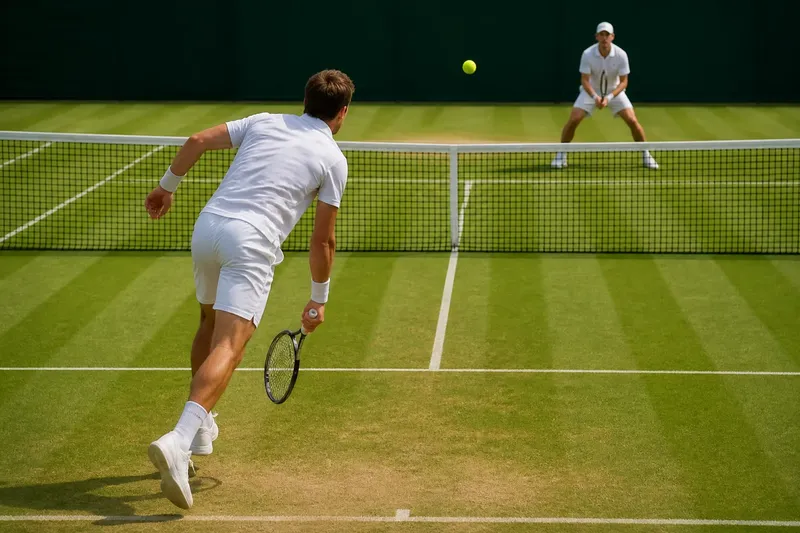
Serve-and-volley or baseline play changes the court a player tries to occupy, not just the look of a point. In serve-and-volley tennis, the server follows the ball towards the net; in baseline play, players usually stay back and build the rally from behind the baseline. Watch where each player moves after serving, then notice how that choice alters the returner’s options.
Two starting positions
A baseline player begins a rally expecting to exchange groundstrokes from the back of the court. The aim is to create a ball that can be attacked: perhaps a deep shot that pushes the opponent back, or an angled one that draws them wide. The player then looks for a shorter reply to approach or strike decisively.
A serve-and-volley player makes the serve the start of a forward movement. After serving, they advance towards the net and prepare to intercept the return with a volley, before the ball bounces or soon afterwards. The serve need not be a winner. Its job is to make the return difficult to control and give the server time to close the distance.
These are broad patterns, not fixed identities. A player who usually rallies from the baseline may come forward behind a short ball. A serve-and-volleyer may stay back after a weak serve or a return that lands awkwardly. The useful question is not simply, “Which style is this?” but, “Where does this player want the next shot to happen?”
Space behind the serve
Advancing behind the serve trades back-court coverage for pressure at the net. The server leaves open space behind and beside them while moving forward, so the returner can try to pass down the line, send the ball cross-court, or lob over the approaching player. Each choice asks the returner to find a narrow target while coping with a fast, often low-bouncing serve.
The server’s approach angle matters. Moving straight towards the centre can cover both sides more evenly, while following a serve towards the sideline may leave a sharper opening on the far side. A good first volley often goes deep or away from the returner, rather than straight for a spectacular winner. That placement makes the next reply harder and gives the server a chance to settle near the net.
The returner, in turn, can change the picture by aiming low at the server’s feet. A volleyer arriving at speed may have to hit upwards, giving the returner time to defend the next ball. A lob is another option when the server closes too tightly, though it requires height and depth as well as accuracy. The returner is not merely trying to hit past a person; they are choosing which gap in the advancing player’s coverage to challenge.
Space from the baseline
Baseline play begins with more time to read the ball and more court behind the player to recover into. That space supports repeated exchanges: the player can use height, spin, depth and direction to move an opponent before risking a more forceful shot. A heavy, deep ball can limit the opponent’s angles; a shorter angled ball can pull them out of position.
But staying back gives the opponent room to take the ball early or approach the net. A baseline player must decide whether to defend, redirect or step in. If they keep hitting safely to the middle, the rally may remain neutral. If they go for the sideline too soon, a small miss can hand over the point. Strong baseline tactics often come from patiently changing one feature at a time: first depth, then direction, then pace.
Position is flexible even within a baseline rally. After hitting cross-court, a player generally recovers towards the likely reply rather than returning automatically to the exact centre. If the opponent is stretched wide, the open court may invite a change of direction; if the ball is short, moving forward can prevent the opponent from recovering comfortably. Baseline play is therefore not passive. It is a way of using the whole rally to create a favourable moment to advance or attack.
What changes the choice
A player’s serve, movement and preferred contact point all shape which approach makes sense. A strong, well-placed serve may produce a manageable first volley. A serve that sits up or lands where the returner can attack may make the forward run a poor bargain. On the returner’s side, a compact swing and reliable low return can make it harder for a server to reach the net comfortably.
Court conditions matter too. A ball that stays low can make volleys and half-volleys demanding, while a higher bounce may give a server more time to get forward after the serve. The surface, weather and ball behaviour can alter these tendencies, but they do not dictate a single tactic. Players still read the incoming ball and adjust their position.
Imagine a player whose serve pulls the returner wide, but whose next shot is often left short. If they rush directly to the net, the returner may have an easy passing angle. They could instead follow a controlled serve, split-step near the service line and judge the return before committing further. The observable difference is that the player reaches the first volley in balance, with a better chance to cover either side.
How do the styles meet?
Can a baseline player come to the net?
Yes. A baseline player can approach when a deep or angled shot draws a short reply, then use a volley to finish or control the point. The approach is a response to the rally’s opening, not a change of identity.
Does serve-and-volley mean rushing every serve?
No. The server needs enough time and a return they can handle while moving forward. Staying back can be the sounder choice if the serve is vulnerable or the return arrives low and fast.
What should I watch after the serve?
Track the server’s first steps and the returner’s contact point. Together they show whether the server is trying to claim the net, hold the baseline or wait to see how the rally develops.
Which style is easier to follow?
Neither is inherently easier to understand. Serve-and-volley makes the contest over net position visible at once, while baseline play reveals a slower exchange of depth, angles and patience.
Read the next space
To read serve-and-volley or baseline play, follow the space each player is trying to create or deny. When the server advances, look for the passing lane or the low ball at their feet. When both players stay back, watch who is pushed away from a comfortable contact point and who can step forward first.
That small habit makes tactical shifts easier to spot. A player can begin a point from the baseline, approach behind a short ball and finish at the net; another can start forward, then retreat when the return forces them to defend. The position of the next shot matters more than the label attached to the player.