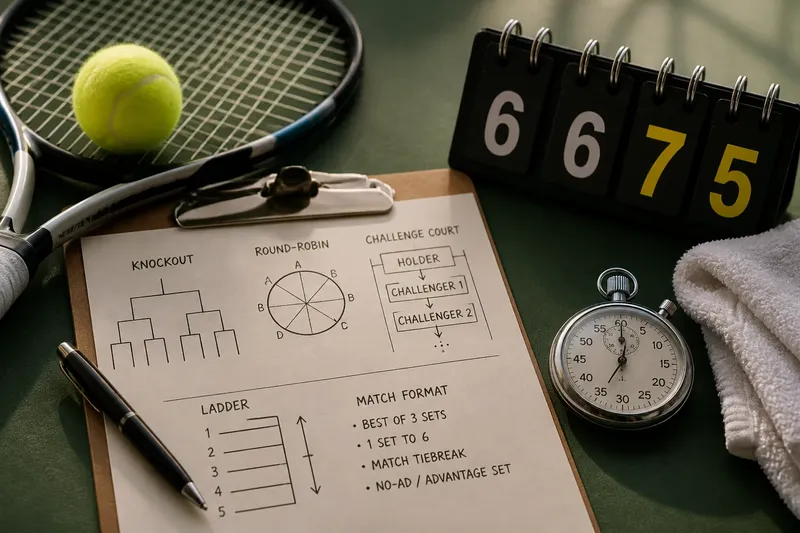
How Tennis Point Scores Work in an Advantage Game
Understand tennis point scores in an advantage game, from love to deuce, and tell when a point can end the game or only bring the score level.
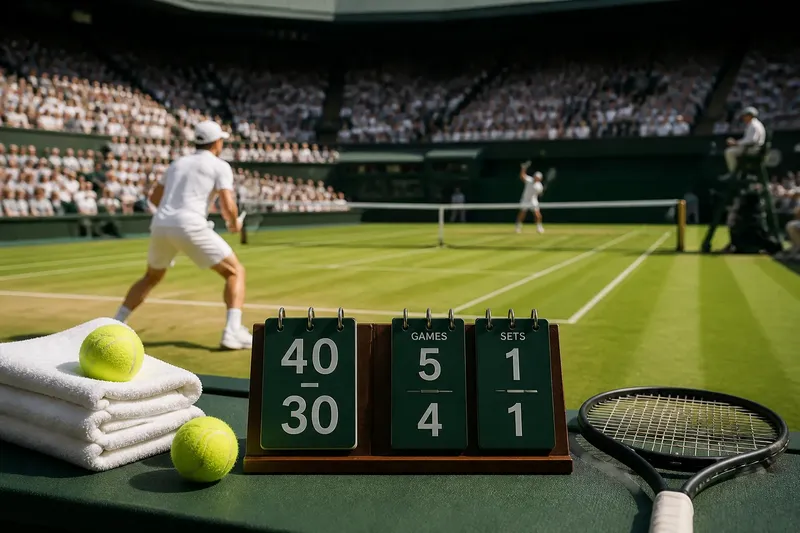
Tennis point scores in an advantage game use the calls love, 15, 30 and 40, but the winning rule matters more than the labels. At 40–30, for instance, the player ahead can take the game with the next point; at 40–40, called deuce, neither player is yet one point from winning.
Three score layers
Keep the points in the current game separate from the games in the set and the sets in the match. A broadcast might show one player leading by a set, the current set at four games to three, and the game in progress at 30–15. Each figure answers a different question.
When a game ends, its point score resets for the next game. The set’s game count changes instead. A set win then changes the match’s set count if play continues.
Point score labels
In an advantage game, the calls are love, 15, 30 and 40. Love means no points won in that game; 15 means one, 30 means two, and 40 means three. These are names for stages, not numbers to add together.
Suppose the umpire calls 30–15. The first player has won two points and the second has won one. If the first wins the next rally, the call becomes 40–15; if the second wins, it becomes 30–30. Neither result changes the game count.
Winning from deuce
In advantage scoring, a player wins a game by reaching at least four points and leading by two. So at 40–30, the player ahead can win the next point. At 40–40, both have won at least three points, and a player must win two points in a row to close the game.
The first point after deuce gives its winner advantage. If that player wins the next point, the game ends. If the opponent wins it, the score returns to deuce. This is why an advantage game can continue beyond four points.
Advantage or no-ad?
The two-point rule applies to advantage games. Some competitions use no-ad scoring, where a deciding point at deuce ends the game instead. Check the event rules or broadcast graphic before assuming every 40–40 call needs two more points.
- At 40–30: check whether the format is advantage or no-ad. If it is either format, the player ahead can win the next point; if the call is actually 40–40, use the deuce rule instead.
- At 40–40: check the competition’s scoring format. If it is advantage, look for a call of advantage after the next point; if it is no-ad, watch for the deciding point and follow the event’s rule for who receives it.
- After advantage: check who wins the next rally. If the player with advantage wins, the game ends; if the other player wins, the score returns to deuce.
- After a game ends: check the point call and set’s game count. If the point call resets, move the game count on for the winner; if it does not, keep following the current game.
- At six games all: check the set format shown by the event. If a tiebreak is required, follow its running point count; if another deciding arrangement applies, use that event rule instead.
- At 40–15: check whether the player with 40 wins the rally. If so, that player takes the game; if not, update the call to 40–30 and keep watching the game.
Games and sets
A common set format requires a player to win six games with a lead of at least two. Six games to four ends the set, while six to five does not: the player behind can still draw level. If the score reaches six-all, a tiebreak or another deciding arrangement may apply, depending on the event.
A tiebreak uses a running count of points rather than love, 15, 30 and 40. Its target and the set format can vary, so read the event’s rules rather than assuming one arrangement applies everywhere.
What do tennis calls mean?
Why does tennis say love?
Love means the player has won no points in the current game. It is a label for the score, and it resets when another game begins.
What does 40–40 mean?
In an advantage game, 40–40 is deuce: both players have won at least three points. The next point gives one player advantage, but that player must win the following point as well.
Can a tennis game last more than four points?
Yes. In an advantage game, a player needs a two-point lead to win. If the players keep trading points after deuce, the game continues until one wins consecutive points.
Does six games always win a set?
No. In a common set format, the player needs six games and a lead of at least two. At six-all, the event may use a tiebreak or another deciding arrangement.
Read the score live
Say you join a match with one set each, five games to four in the current set, and 40–30 in the game. The player on five games is serving and leads the point score. If that player wins the next rally, the game ends and the set score becomes six games to four. If the player on four wins, the point call becomes 40–40; the set remains five-all only after that player wins the game. The distinction shows how the point call predicts the next change, while the game count tells you what that change means for the set.
When a score is hard to follow, look first at the point call, then the set’s game count, then the match’s set count. If the point call is 40–30, ask whether the next rally can end the game. If it is 40–40, check whether the event uses advantage or no-ad scoring. That small check is the quickest way to read tennis point scores correctly.