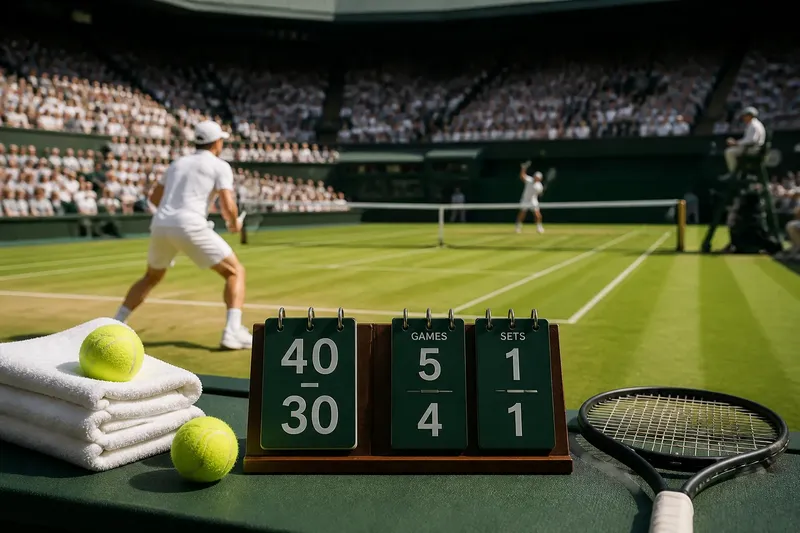
From Challenge Court to Tiebreak: Why Match Formats Change
Tennis match formats shape who plays, how long a contest lasts and what each result means. Learn to read the choices behind the rules.
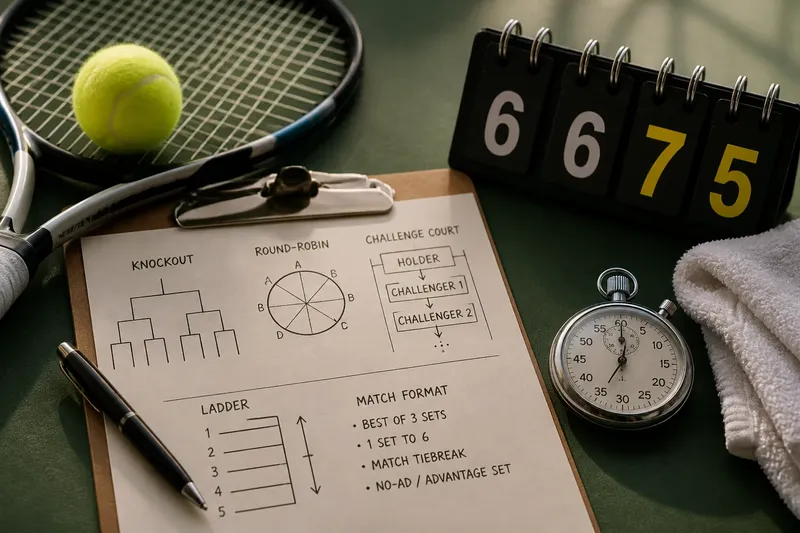
Tennis match formats decide who gets on court, how a contest progresses and what counts as a useful result. To understand tennis match formats, start by asking what the organiser needs the competition to do: find a champion, give everyone a game, keep play moving or let winners defend a place.
That question makes a challenge court and a tiebreak easier to understand. They are not merely unusual ways to keep score. Each format solves a different problem, and each changes the choices players face. Here is a practical way to read those choices in order.
Start with the purpose
Before following the rules, identify the event’s main aim. A club evening might prioritise participation. A knockout draw is designed to produce a winner. A teaching session may use short matches so players can practise competing without setting aside a long stretch of time.
Ask yourself:
- Does everyone get to play, or can one loss end a player’s day?
- Is the organiser trying to identify the strongest entrant across a field?
- Does the format need to fit into a fixed session or shared court booking?
- Will players meet the same opponent once, or can they return through a ladder or challenge system?
These answers tell you what to watch. In a knockout, each match has immediate consequences for the draw. In a social round-robin, a single loss may matter less because players have further matches. Neither arrangement is automatically fairer: they reward different things and serve different needs.
Follow the competition path
Next, sketch how a player moves through the event. In a knockout bracket, a player advances by winning and is eliminated by losing. The structure is simple to follow, but it can give a player little court time after an early defeat.
A round-robin groups players so each meets the others in that group. Results are then compared to decide who progresses, if anyone does. It offers more direct match-ups, though organisers must explain how tied records are separated. A league or ladder takes a longer view: players accumulate results or challenge for positions over repeated meetings rather than leaving after one defeat.
Challenge-court formats add a visible target. A player, or sometimes a pair, holds the court while challengers wait for a chance to take that position. In a club session, the court might be reserved for the current holder, with a short match deciding whether the challenger stays or takes over. The attraction is clear: a contest forms quickly and there is a reason to watch the next game. The trade-off is that players waiting their turn may have less time on court, particularly if a holder keeps winning.
Imagine a club with one court and a queue of players. If its aim is to keep games rotating, the organiser could set a short challenge match and then move both players to the back of the queue. The observable result would be more frequent changes of opponents and fewer long runs by one holder. If the aim is to reward defending the court, the organiser could instead let the winner stay, while making the waiting order clear.
Read the match length
Now check how much tennis makes up an individual match. A full match may use sets, while a short-format event might use a single set, a first-to-a-mark contest or a match tiebreak in place of a deciding set. These choices change the time commitment and the shape of the contest.
Short formats can make it easier to schedule several matches in one session. They also make each game or point feel more consequential, because there is less time to recover from a slow start. Longer formats give players more room to adjust, but ask more of the schedule and of the people waiting to play.
A tiebreak has a specific role: it provides a compact way to decide a set or, in some formats, a match. It is not simply a miniature version of a whole match. The serve changes hands according to a set sequence, and players switch ends at prescribed moments. If you are watching, check whether the tiebreak decides only the set or the entire contest; that distinction affects what the result means.
Also notice whether the format includes a deciding advantage set or uses a tiebreak to resolve a close set. An advantage set continues until one player gets clear separation, while a tiebreak gives the set a defined finish. One favours endurance and extended pressure; the other makes a finish easier to plan. The event’s own rules determine the exact format.
Check how results count
A format is not complete until you know how the organiser compares results. In a knockout, the path is direct: win and advance. In a round-robin, the organiser may need a ranking method when players finish with similar records. Match wins, sets won or games won can be used, depending on the event’s published rules.
This is why a player’s aim can change from match to match. Someone who has already secured progress may have a different priority from a player who needs a strong score to stay in contention. You do not need to calculate every possible outcome while watching. Just find out whether the next result affects advancement, position or only that match.
For informal competitions, organisers should tell players the comparison method before play begins. If the rule is unclear, ask how a tie in the group will be resolved. Knowing the answer helps everyone understand why a player may keep competing hard even after a match appears decided.
Match format questions?
What is a challenge court in tennis?
A challenge court is an arrangement in which a player or pair holds a court and waiting opponents get a chance to challenge them. The organiser sets the queue and match length, so those details determine how quickly players rotate.
Why do tennis events use tiebreaks?
A tiebreak gives a close set or match a defined way to finish. It can make court scheduling more predictable, while creating a concentrated contest in which each point carries unusual weight.
What is the difference between round-robin and knockout?
In a round-robin, entrants play several opponents in their group and results are compared. In a knockout, a loss usually ends an entrant’s progress, so the draw produces a winner through successive eliminations.
Does a shorter match format change the winner?
It can change which qualities have the most opportunity to matter. A short match leaves less room to recover from a poor start, while a longer one gives players more time to adjust; the format does not make either outcome certain.
Choose what to watch
When you arrive at a match, take a moment to locate the format’s key decisions: who advances, how long each match lasts and how tied results are separated. Then watch for the way those conditions shape the contest. A player who needs a quick win may take risks early; someone defending a challenge court may focus on holding position. These are possible responses, not rules about how every player must behave.
If you are choosing a format for a club session, match the structure to the purpose. Use a round-robin when giving entrants several opponents matters. Choose a knockout when a clear elimination path is the priority. Consider a challenge court when a visible queue and repeated contests suit the group. Short sets or match tiebreaks can help fit play into a limited booking, provided everyone understands what decides the match.
Before anyone serves, explain the route through the event, the match length and the method for ranking tied results. Those three details let players read the competition as it unfolds. They also reveal the central point behind tennis match formats: the rules do more than organise time on court; they decide which kind of contest the players are being asked to play.